See where water risk is concentrated across assets, issuers, and portfolios.
True Elements connects physical assets to the water systems they depend on, then carries that evidence into issuer and portfolio analysis. Investment teams can compare exposures through one consistent approach, open rolled-up conclusions to the sites and assumptions beneath them, and monitor what changes across the periods they expect to hold an investment.
Physics-informed modeling. Integrated environmental science. Advanced reasoning.
From a physical asset to an investment conclusion the investment committee can examine.
See how True Elements connects asset-level water conditions to wider issuer and portfolio exposure, while keeping the underlying locations, evidence, and assumptions available for review.
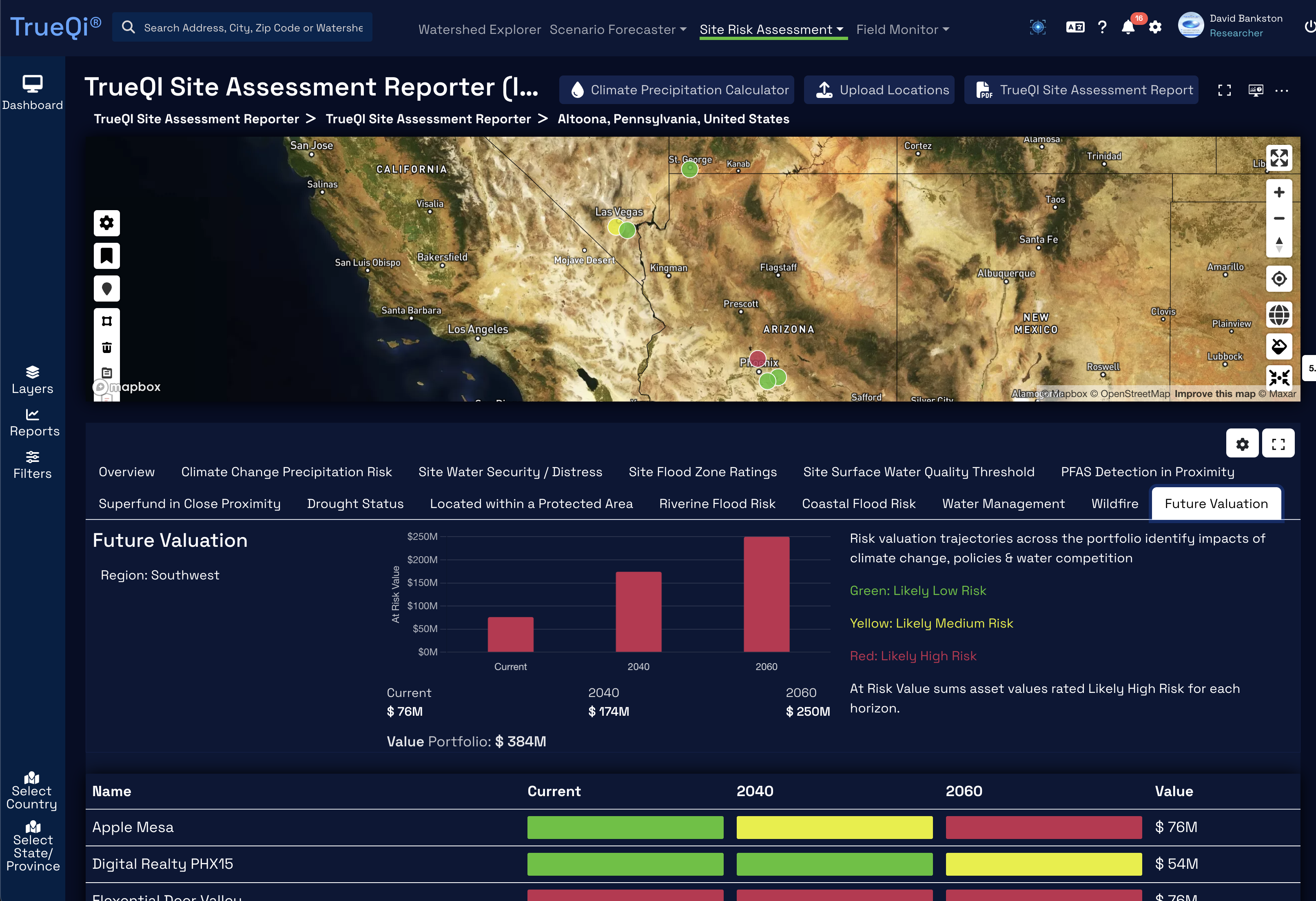
Actual True Elements interface. Demonstration values are illustrative unless otherwise identified.
One investment question becomes a traceable investigation from asset to portfolio.
Define the asset, issuer, portfolio, holding period, and investment question the team needs to examine.
Identify the facilities and locations beneath the investment, then examine the watersheds, conditions, dependencies, and relevant evidence surrounding them.
Compare exposures through one consistent method, distinguish short-term variation from longer-term change, and identify where deeper diligence or engagement may be warranted.
Open rolled-up findings to their underlying sites, evidence, and assumptions, then use Argus™ to organize the investigation for qualified review.
One asset is the test case. The value is one traceable standard across every investment decision.
Water exposure is often reduced to a portfolio score, sector assumption, issuer disclosure, or one-time diligence report. Those views can hide the physical assets and shared water systems beneath the number. They can also make it difficult to compare conclusions produced by different analysts, data providers, and advisors.
True Elements begins with the asset and the water system it depends on. The same evidence structure can then support issuer analysis, portfolio comparison, diligence, engagement, and continued monitoring. An investment team can see where exposure is concentrated and open a rolled-up conclusion to the specific locations and assumptions behind it.
The enterprise value is not another score. It is a repeatable and examinable way to understand water exposure across assets, issuers, portfolios, and investment decisions.
Connect the financial conclusions to the physical water evidence beneath them.
Private-asset diligence
Examine site-level water conditions, dependencies, and changing scenarios that may affect operating assumptions, permitting, resilience, or long-term asset value.
Portfolio concentration
Identify where multiple holdings, issuers, or facilities depend on the same constrained water systems or share exposure to changing regional conditions.
Public-equity research
Trace an issuer's material facilities to the water systems they depend on so concentrated physical exposure does not disappear inside a sector or company average.
Engagement and governance
Compare company disclosures with observable asset-level evidence and focus engagement on the locations, dependencies, and assumptions that merit examination.
Scenario and holding-period analysis
Examine how water conditions may change across relevant investment periods and distinguish temporary variation from potentially structural change.
Diligence and committee evidence
Use Argus™ to organize company, sector, location, and source evidence into an investigation record that qualified teams can review and carry into their own decision process.
Not a black-box portfolio score. A conclusion you can open and examine.
True Elements brings three capabilities together. Each has a different job, and each keeps the investment conclusion connected to the physical world beneath it.
TrueQi® constructs the intelligence. Argus™ investigates it. Your team decides and acts.
True Elements supports research, diligence, monitoring, and decision-making. Final financial, investment, fiduciary, legal, regulatory, underwriting, valuation, and capital-allocation judgments remain with the organization's qualified professionals.
1. Physics-informed modeling
Models water movement, balance, physical relationships, and relevant operating conditions around the asset and the water system it depends on.
2. Integrated environmental science
Connects hydrology, climate, water quantity, water quality, land, infrastructure, and other relevant conditions around the investment question.
3. Advanced reasoning
Argus™ directs the investigation across TrueQi®, organizes the findings, and keeps source evidence and model outputs available for qualified review.
The demonstration is only the starting point.
Every institution has different assets, mandates, holding periods, sectors, diligence standards, and materiality thresholds. The same connected intelligence can be directed toward the investment question the team actually needs to examine.
- Where is water exposure concentrated across our assets, issuers, or portfolio?
- Which holdings depend on the same water systems or face similar regional conditions?
- Does an issuer's disclosure align with the conditions surrounding its material facilities?
- Which assets warrant deeper diligence, engagement, or continued monitoring?
- How could changing water conditions affect our assumptions across the expected holding period?
- What source evidence and assumptions support this portfolio-level conclusion?
These are representative questions, not the limits of the system.
Bring us the investment question your organization needs to answer.
Whether it involves one asset, an issuer, a transaction, or a portfolio, True Elements can show your team the connected water and environmental intelligence surrounding it and what can be investigated next.