Every answer should carry the evidence behind it.
Data Foundation preserves the source, date, location, lineage, methods, and limitations that give water and environmental evidence meaning. It gives TrueQi® a consistent, reviewable basis for investigation across sites, assets, portfolios, communities, and watersheds.
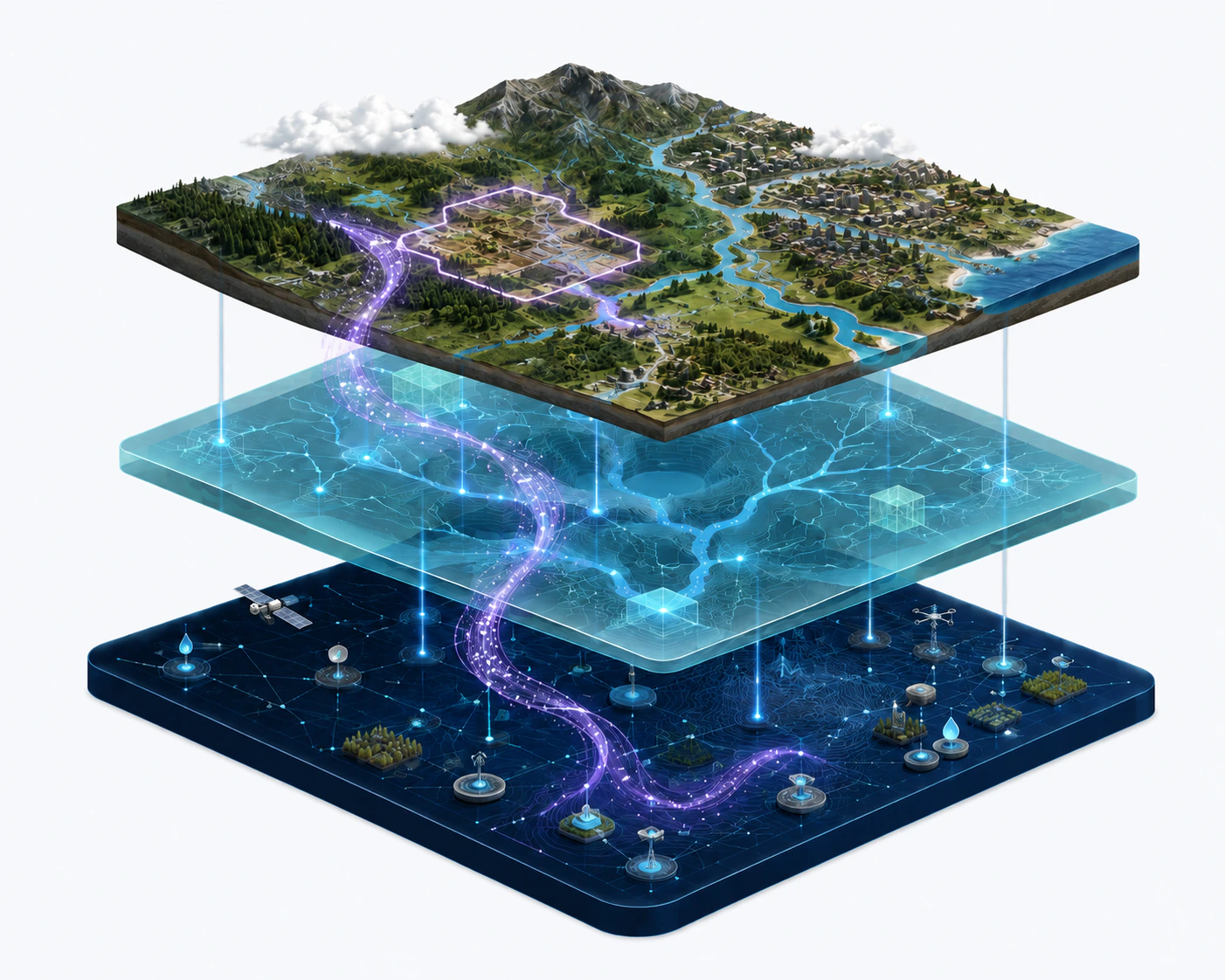
Data without context cannot support consistent investigation.
A value, layer, or model output can look precise while leaving essential questions unanswered. Where did it come from? When was it observed? What place does it represent? How was it prepared? What limitations travel with it?
Data Foundation is designed to keep that context attached to the evidence so teams can examine what they are using, compare it with other evidence, and understand where qualified review is still required.
- Where did it come from?
- When was it observed?
- What place does it represent?
- How was it prepared?
- What limitations travel with it?
The record matters as much as the value.
Evidence becomes more useful when the information needed to interpret and review it remains connected. Data Foundation organizes that record around six practical questions.
Where did it come from?
Preserve the originating source and the evidence needed to identify it.
What location and period does it represent?
Keep the relevant geography, timestamp, reporting period, or observation window with the record.
What does the value measure?
Retain the units, resolution, boundary, and scale required to interpret it correctly.
How was it produced?
Distinguish observations, estimates, models, forecasts, and other evidence types where that information is available.
What happened to it along the way?
Record relevant transformations, versions, and connections used to prepare the evidence for investigation.
What should the reviewer keep in mind?
Keep known gaps, uncertainty, assumptions, source restrictions, and other material qualifications available for review.
New evidence should add context, not erase history.
Water and environmental evidence changes across reporting periods, methods, sources, and locations. Data Foundation is designed to preserve enough lineage to show what entered the investigation, how it was prepared, and what changed when the context is revisited.
Receive
Identify the source, place, time, method, and available qualifications.
Prepare
Structure evidence for use while preserving relevant source context.
Connect
Make the evidence available to the relationships and investigation defined in TrueQi®.
Revisit
Keep prior context available when new evidence, assumptions, or questions require another review.
Gaps and conflicts should remain visible.
Sources can differ because they represent different dates, boundaries, methods, resolutions, or assumptions. Missing evidence can be just as important as the evidence that is present. The foundation should preserve those distinctions so qualified people can judge what is relevant to the question.
DIFFERENT SOURCES
Keep source identity and context available instead of forcing unlike evidence into false agreement.
MISSING EVIDENCE
Make material gaps visible so they can be considered in the investigation.
OBSERVATIONS AND MODELS
Distinguish what was observed from what was estimated, modeled, or forecast where the source information supports that distinction.
Uncertainty documented. Judgment retained by your people.
The foundation keeps the system grounded in evidence.
Data Foundation preserves the context needed to review the evidence. Other capabilities inside TrueQi® connect that evidence, examine relevant relationships, and support investigation around the organization’s question.
Data Foundation
Preserves provenance, continuity, and trust.
Data Constellation
Connects environmental evidence by place, time, and relationship.
Modeling and environmental science
Examine the physical and environmental relationships relevant to the question.
Argus™
Directs investigation across the TrueQi® context and organizes findings with supporting evidence and model outputs available for review.
Reviews the evidence and findings, then decides and acts.
Keep the evidence available for review.
Trace the evidence
Return to the relevant source, date, place, method, and lineage available for the investigation.
Review the reasoning
Examine how the evidence, relationships, assumptions, and model outputs support the findings.
Keep the judgment
Give qualified people the context needed to evaluate the work and remain responsible for the decision.
Trust comes from what can be examined, questioned, and understood.
What organizations need to know about the evidence foundation.
Bring us the question your organization needs to investigate.
We’ll show you how TrueQi® can organize the evidence, relationships, and context your team needs to investigate it.
Request a Briefing