See where to grow, source, and invest as water and climate conditions change.
True Elements connects growing regions, commodities, water balance, climate, productivity, ecological outcomes, and financial assumptions in one working environment. Your team can compare locations, test regenerative strategies, examine potential outcomes, and continue monitoring the path selected across the portfolio.
Physics-informed modeling. Integrated environmental science. Advanced reasoning.
From a portfolio question to a comparable set of growing and sourcing options.
See AgForward™ compare locations, commodities, and regenerative scenarios, while Argus™ investigates the results and organizes the evidence for review.
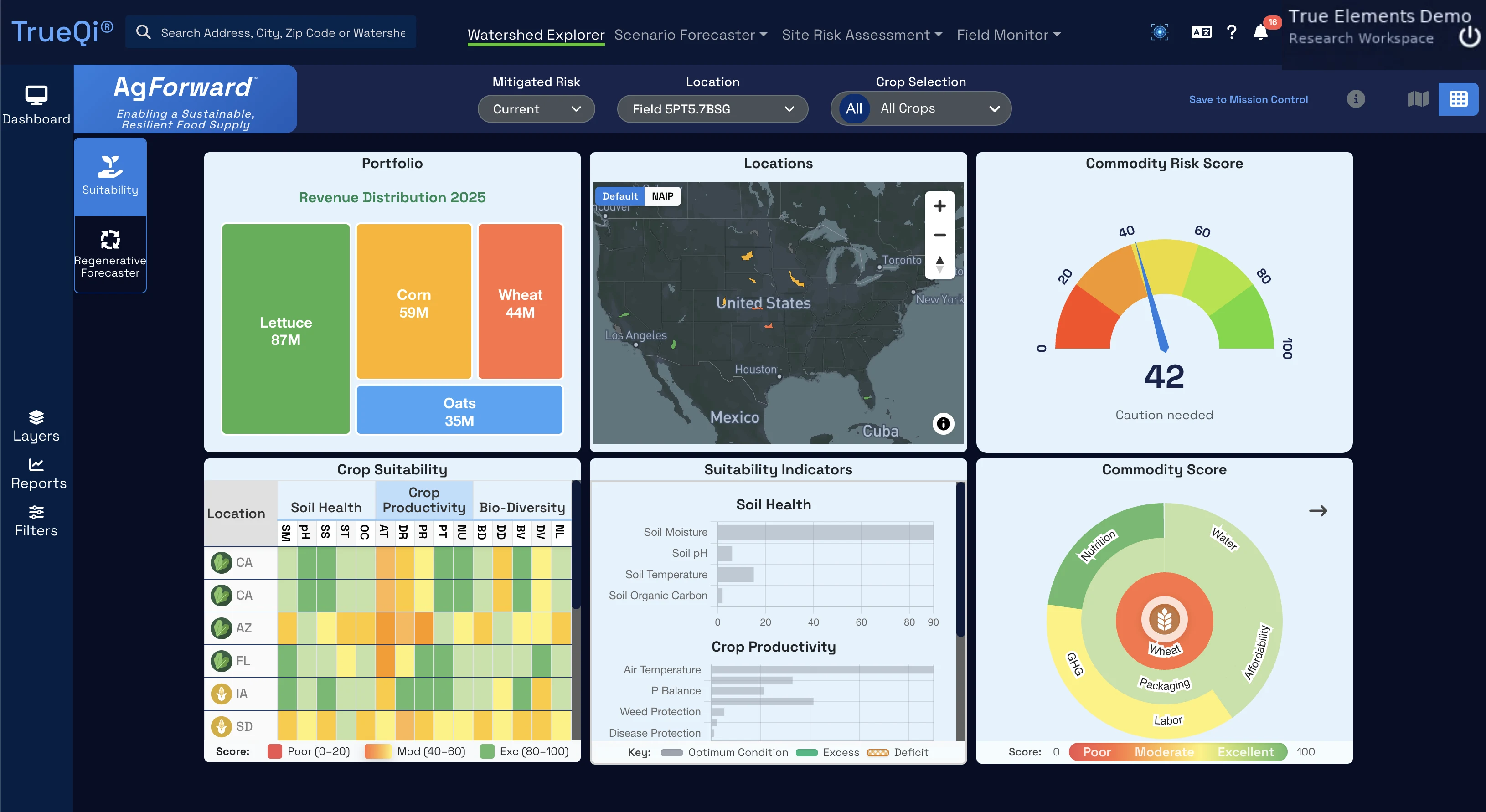
Actual AgForward™ interface. Demonstration values are illustrative unless otherwise identified.
One portfolio question becomes a comparable investigation across locations, commodities, and potential interventions.
Define the commodity, locations, time horizon, and business question your team needs to investigate.
Examine water balance, climate, soil, productivity, ecological conditions, and other relevant evidence across locations.
Compare the current path with regenerative practices, sourcing options, or other scenarios your team is considering.
Examine potential environmental and financial outcomes, then use Argus™ to organize the findings and supporting evidence for review.
One location is the test case. The value is one standard across every growing and sourcing decision.
Agriculture decisions are often investigated as separate projects, by different teams, with different consultants, assumptions, and evidence. That makes it difficult to compare one region, commodity, supplier, or intervention with another.
True Elements gives the organization one working environment for framing the question, connecting the relevant evidence, applying the same intelligence, and continuing to monitor what changes. A team can begin with one field or watershed, then apply a consistent investigation across regions, commodities, suppliers, and the broader portfolio.
The enterprise value is not one answer. It is a repeatable and examinable way to reach better-supported answers across the organization.
Connect the decisions that agriculture teams are usually forced to examine separately.
Physical and transition risk
Examine how drought, flood, water stress, changing climate conditions, and transition requirements could affect growing regions, operations, and sourcing relationships.
Supply-chain vulnerability
Identify where suppliers, facilities, watersheds, water quality, and regional conditions may create concentrated exposure across the supply network.
Where to grow
Compare candidate regions and commodities using water balance, climate, soil health, productivity, biodiversity, and longer-term conditions.
Where to source
Compare sourcing regions through a common evidence structure so procurement and operating teams can see dependencies, tradeoffs, and changing conditions more clearly.
Nature-based investment priorities
Examine where cover crops, reduced tillage, biodiversity restoration, precision irrigation, or other interventions may offer the strongest potential under local conditions.
Environmental and financial scenarios
Compare potential ecological outcomes, recurring costs, transition requirements, and financial assumptions before committing resources.
Not another agriculture dashboard. A connected, examinable investigation.
True Elements brings three capabilities together. Each has a different job, and each makes the others more useful.
TrueQi® constructs the intelligence. AgForward™ applies it to agriculture. Argus™ investigates it. Your team decides and acts.
True Elements supports investigation and decision-making. Final agronomic, operational, financial, legal, regulatory, sourcing, and investment judgments remain with the organization's qualified professionals.
1. Physics-informed modeling
Models water balance, movement, physical relationships, and relevant operating assumptions so the investigation remains connected to how water and environmental systems behave.
2. Integrated environmental science
Connects hydrology, climate, soil health, biodiversity, productivity, water quality, and other relevant conditions around the place and decision being examined.
3. Advanced reasoning
Argus™ directs the investigation across TrueQi® and AgForward™, organizes the findings, and makes the underlying evidence and model outputs available for review.
The demonstration is only the starting point.
Every organization has different commodities, geographies, operating conditions, suppliers, investment priorities, and questions. The same connected intelligence can be directed toward the decision your team actually needs to make.
- Which regions are best positioned for a commodity as water and climate conditions change?
- Where are supplier and watershed dependencies concentrated across our portfolio?
- How do the current path and regenerative strategies compare across locations?
- Which interventions show the strongest potential environmental and financial outcomes under local conditions?
- Where could changing conditions alter sourcing, operating, or capital priorities?
- What evidence should we continue to monitor after a decision is made?
These are representative questions, not the limits of the system.
The same connected intelligence can be directed toward different responsibilities across the organization.
Corporate Sustainability, Resilience & Supply Chain
Connect facilities, suppliers, energy, and shared water dependencies.
Finance & Investment
Evaluate exposure from asset to issuer to portfolio.
Government & Infrastructure
Examine development alongside competing public and basin needs.
Consultancy & Advisory
Apply a reusable evidence and modeling foundation across client engagements.
Bring us the agriculture question your organization needs to answer.
Whether it involves one field, a sourcing region, a commodity portfolio, or a global supply network, True Elements can show your team the connected water and environmental intelligence surrounding it and what can be investigated next.