See the water resource as one connected system.
Water Resource Intelligence connects supply, demand, quality, infrastructure, climate, policy, and communities within the physical water system they share.
It helps teams investigate how a proposed action or changing condition may affect the resource and the people, operations, assets, and ecosystems connected to it.
Physics-informed modeling. Integrated environmental science. Advanced reasoning.
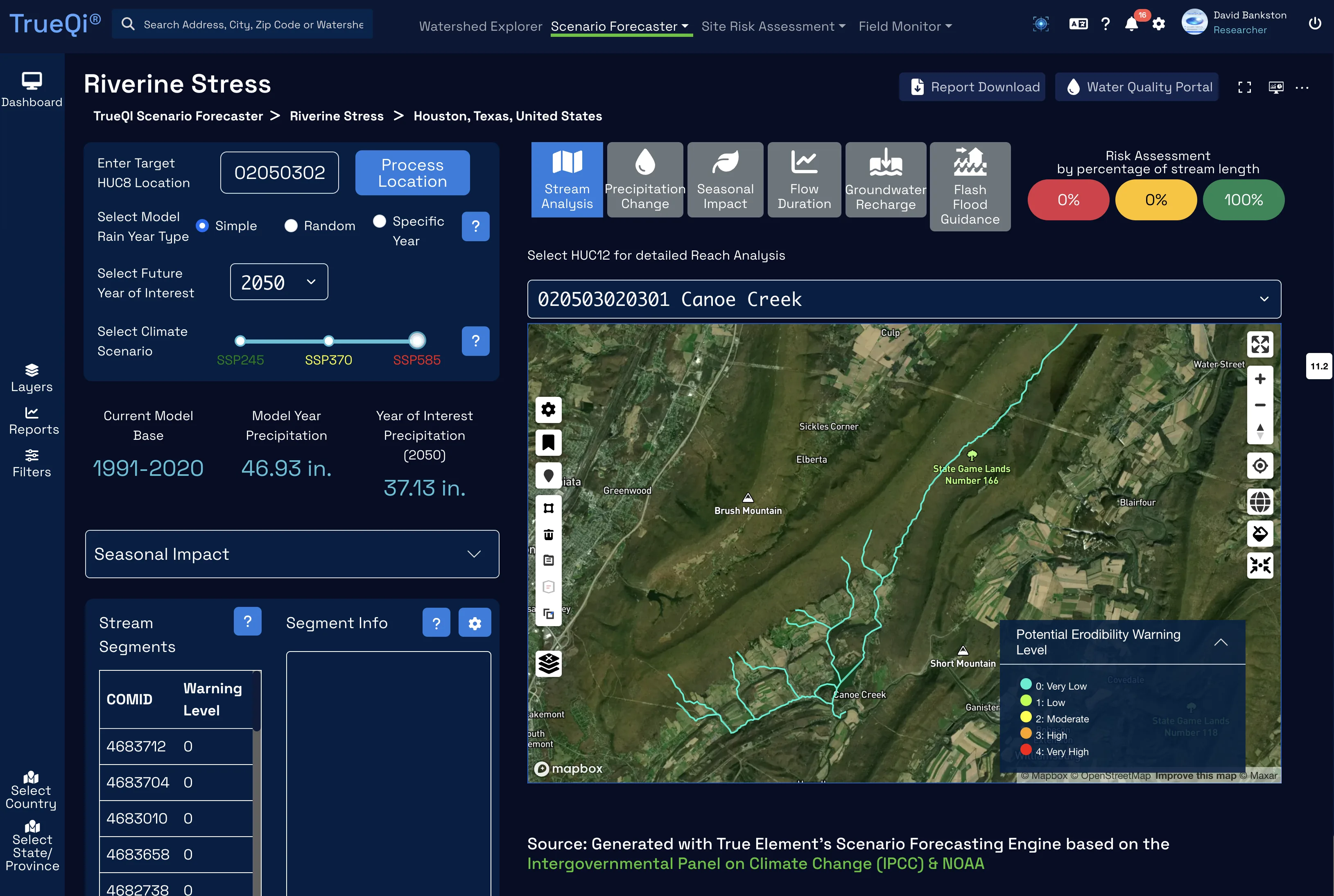
A water resource does not stop at a project, property, service area, or jurisdictional boundary.
Surface water, groundwater, reservoirs, infrastructure, water quality, climate, demand, policy, and community needs interact across the same physical system.
Examining only one boundary can miss the upstream conditions, downstream effects, shared dependencies, and competing uses that shape the question.
One physical water system. Many connected responsibilities.
Begin with the question. Investigate the connected water system around it.
The investigation starts with the organization's actual need, then brings together the places, conditions, relationships, assumptions, and evidence required to examine it in context.
FRAME THE QUESTION
Define the place, responsibility, time horizon, and decision context the team needs to examine.
DEFINE THE WATER SYSTEM
Identify the relevant watershed, basin, aquifer, reservoir, infrastructure, service area, or connected geography.
CONNECT THE EVIDENCE
Bring together the relevant supply, demand, quality, climate, infrastructure, policy, and community context.
EXAMINE THE RELATIONSHIPS
Investigate how conditions and proposed actions may interact across the connected system.
CONTINUE THE INVESTIGATION
Return to the evidence as conditions, assumptions, or organizational questions change.
The water resource is connected. The investigation should be too.
Connect the water-resource questions that are usually examined separately.
The relevant evidence depends on the question. These are representative areas of investigation, not the limits of the system.
WATER AVAILABILITY AND RELIABILITY
Examine source conditions, storage, recharge, flows, demand, infrastructure, and other factors affecting water availability over the relevant place and time horizon.
COMPETING DEMANDS
Compare municipal, industrial, agricultural, ecological, Tribal, and other uses within the connected water system and the limits of the available evidence.
WATER QUALITY
Investigate available quality observations, potential stressors, movement through the water system, affected uses, and the source context surrounding the evidence.
INFRASTRUCTURE AND DEVELOPMENT
Examine how existing infrastructure, proposed development, source choices, operating assumptions, and shared system demands relate.
CLIMATE AND CHANGING CONDITIONS
Compare relevant historical evidence and approved future scenarios to understand how changing conditions may alter the water-resource context.
POLICY AND COMMUNITY IMPLICATIONS
Organize hydrologic, infrastructure, jurisdictional, community, and policy context so qualified teams can examine tradeoffs and responsibilities together.
True Elements supports investigation and decision-making. Final engineering, scientific, operational, legal, regulatory, policy, investment, and public-interest judgments remain with the responsible qualified professionals and authorities.
The same water system can sit beneath many organizational questions.
Water Resource Intelligence provides a connected context. Each organization applies that context to the responsibilities, assets, communities, operations, or clients it serves.
Government & Infrastructure
Examine competing demands, infrastructure, development, public responsibilities, and community effects across one connected hydrologic context.
Data Centers
Examine water sources, infrastructure, operating assumptions, climate conditions, and shared demands across candidate and operating sites.
Agriculture & Food
Compare water balance, growing regions, commodities, suppliers, ecological conditions, and potential interventions.
Corporate Sustainability, Resilience & Supply Chain
Trace shared water dependencies across facilities, suppliers, operations, growth plans, and commitments.
Consultancy & Advisory
Apply a reusable Water Intelligence foundation to different client questions while preserving professional judgment.
Finance & Investment
Carry water-resource evidence from individual assets through issuer, portfolio, and investment analysis.
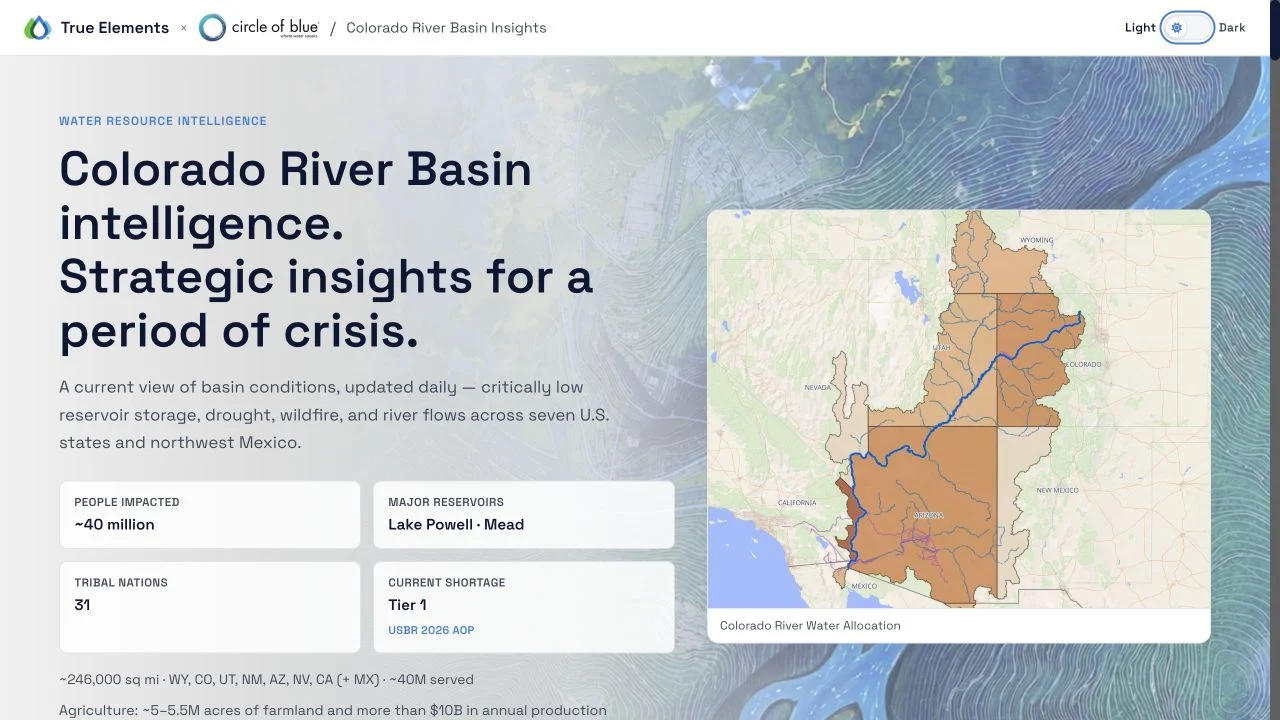
One river system. Many connected decisions.
The Colorado River Basin connects reservoir storage, drought, snowpack, runoff, streamflow, fire conditions, shortage status, infrastructure, communities, and economies across one shared water system.
The Water Observatory brings relevant evidence and context together so people can examine current conditions, source timing, uncertainty, related impacts, and what to monitor next.
The answer is not separated from the water system behind it.
True Elements brings three different disciplines into the same investigation. Each has a distinct role, and the supporting context remains available for qualified review.
PHYSICS-INFORMED MODELING
Represents water movement, balance, continuity, and relevant physical relationships within the system being examined.
INTEGRATED ENVIRONMENTAL SCIENCE
Connects hydrology, hydrography, meteorology, climate, land, water quality, infrastructure, and other relevant context.
ADVANCED REASONING
Helps direct the investigation across the connected system, organize findings, and keep supporting evidence and model outputs available for review.
TrueQi® constructs the connected Water Intelligence context. Argus™ investigates within it. Qualified experts remain responsible for interpretation, decisions, and action.
Questions organizations ask about connected water resources.
Bring us the water-resource question your organization needs to answer.
Whether it begins with a watershed, basin, aquifer, reservoir, infrastructure system, development, community, or operating need, we’ll show you the connected evidence and relationships your team can investigate next.
Request a Briefing